Shop the video
The Soft Autumn fall capsuletwelve pieces, ten jobs
Most capsules are a list of clothes. This one is a list of jobs. Soft Autumn has ten colors in it, and every one of them is assigned a role on your season page — the anchor everything else agrees with, the layer that sits underneath, the shade that goes at your face. Fill the roles and the coordinating happens on its own, because everything came from the same ten colors. The last two pieces are connectors: a boot and a second bottom, which do not get colors of their own but borrow from the ten and turn a list into a wardrobe.
The pieces below are Amazon links, and Your Style Hue earns a commission if you buy through one — at no extra cost to you. Nothing here is paid placement. Each piece was chosen because its color actually matches the shade it sits under. Most come in a dozen colors, so check the one on Amazon matches before you buy.
The twelve pieces · tap one to jump to it


Wear it
Three outfits from the twelve.
Put together from the pieces on this page, so every one works with the rest. Tap a piece to see it on Amazon.
Coral at your face
The wrap goes by your face, cream underneath, warm sand for the rest.
The everyday one
Sage knit, sand pants, the olive bag, and the camel coat over it all.
One loud piece
Pumpkin is the only bright thing. Everything around it stays quiet.


01 · Your anchor neutral
Sage
The anchor is the color everything else in the wardrobe has to get along with, which makes it the one piece worth buying best and wearing most.
Why this worksLess
For Soft Autumn that is sage — a green with grey through it rather than a green with yellow, quiet enough to sit under anything and warm enough to belong to you. Buy this one in the best fabric you can, because it will do more work than anything else here.

02 · Coat, pant
Camel
One color doing two jobs, which is why a camel coat quietly makes about six outfits work rather than one.
Why this worksLess
It is the warmest of your neutrals and the one that reads as considered from across a street. A coat is the largest block of color anyone sees you in and it gets worn in the worst light there is, so this is not the place to take the shade on trust.

03 · Base layer
Warm Sand
The quietest thing in the capsule and the one doing the most, because it is what everything else sits on top of.
Why this worksLess
A tailored pant earns its place here over a softer one: the capsule already has plenty of ease in it, and one structured piece is what stops the whole thing reading as loungewear.

04 · Your white
Cream
Not optic white — cream. Bright white next to a Soft Autumn face reads like a spotlight someone forgot to turn off, and the difference between the two is the single easiest upgrade in this list. Everything a white t-shirt does for an outfit, this does without the drain.

Two down, two to go
Not sure which of these is describing you?
That’s the normal answer, and it’s the whole reason the analysis exists. It reads your undertone, depth and contrast from a photograph and tells you which of the twelve seasons you are — which settles the blazer question in about a minute.
05 · Your depth
Olive
Every wardrobe needs something that goes dark, and for a Soft Autumn that dark is olive.
Why this worksLess
It is carried here by a bag rather than a garment on purpose — depth low in an outfit anchors it, and a bag is the one piece you can put a deeper color into without it arriving at your face first.

06 · Jewelry, a scarf
Burnished Gold
The piece here you will wear every single day, which makes it the one worth getting right rather than the one to economize on.
Why this worksLess
Gold sits at your face without competing with what is around it, and a hoop is the version that goes with everything else on this page without a thought.

07 · Wear at the face
Dusty Coral
This is the one the palette actually gives an instruction about, and the instruction is where to put it.
Why this worksLess
A wrap is about as close to your face as clothing gets, which makes it the most efficient piece in the capsule — it does its whole job the moment you put it on, over anything you already own.

08 · One piece at a time
Soft Pumpkin
The palette says this one out loud, and it might be the most useful line on it: this color is wonderful, and it is wonderful once.
Why this worksLess
One piece, against the quieter things above it — not a pumpkin sweater under a pumpkin coat. Treat it as the loudest thing in an outfit and it will do exactly what you want.

09 · Quiet neutral
Warm Khaki
The second neutral, and the one that stops the whole capsule from being sage.
Why this worksLess
A quarter zip earns its place because it opens at the neck — the collar takes the sage or the coral above it and frames your face rather than closing it in.

10 · Softest at the face
Rose Beige
The same neighborhood as your coral with the volume down.
Why this worksLess
This is the one for days you want to look well rather than look done, and a fine-gauge cardigan is the shape that does it — it goes over the cream tee, under the coat, and sits at your collarbone where it can do its work.

11 · Connector — draws on Camel
The boot
Ten colors do not dress you. Two more pieces are needed, and neither one gets a color of its own — they borrow from the ten above, which is exactly what makes them connectors. The boot wants to sit in your warm end rather than in black: a cognac or a mid brown picks up the camel of the coat and the sand of the pant and closes the outfit at the floor. Black boots under this palette do the opposite — they end an outfit two inches early, and everything above them has to work harder.

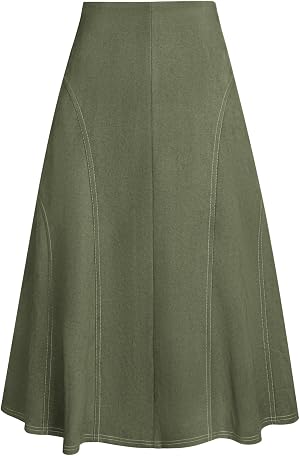
12 · Connector — draws on Olive
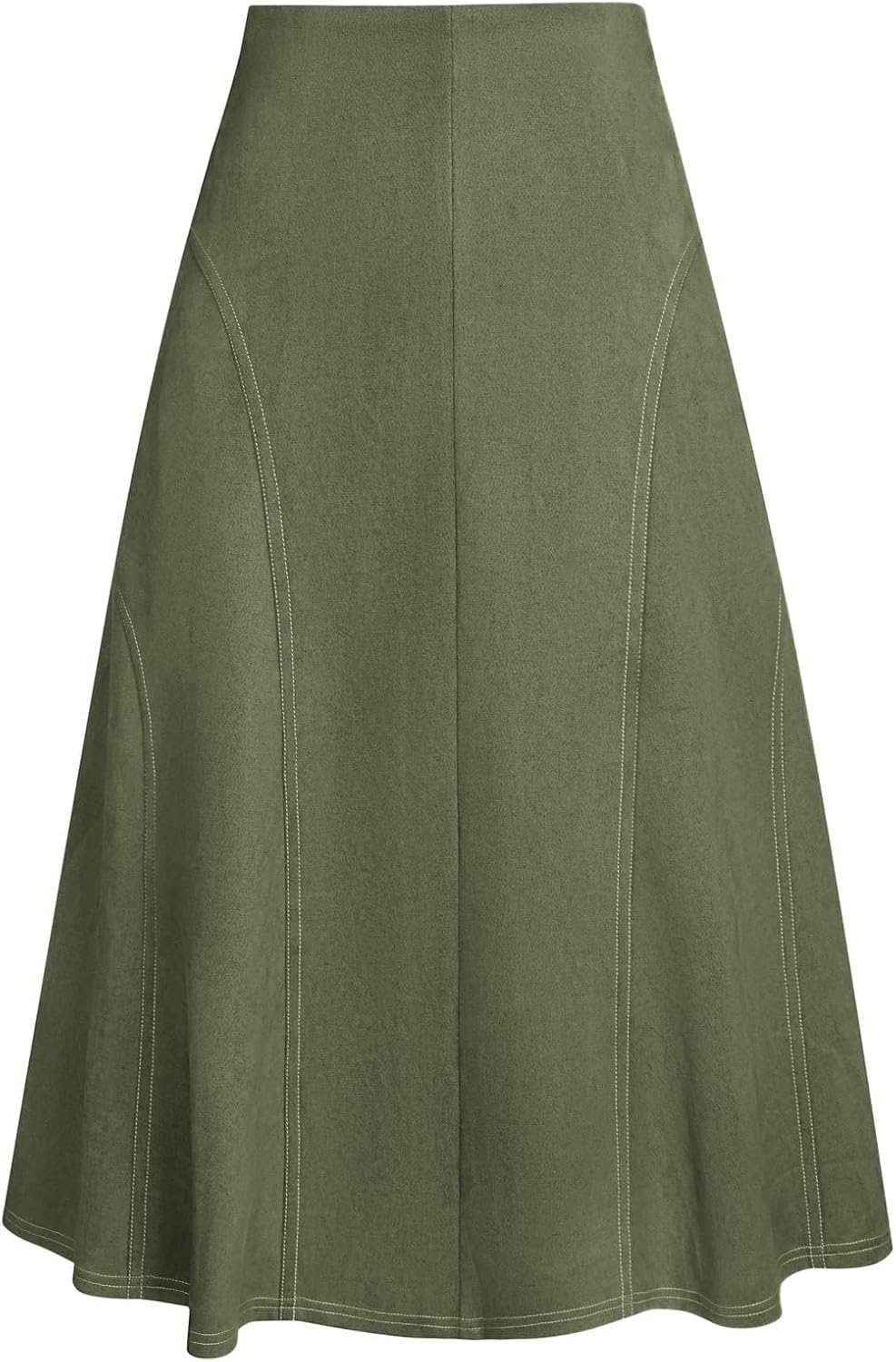
The second bottom
Whatever the first one is not. The pant above is wide, pale and tailored, so the second bottom is none of those: a suede A-line in your depth, which is the single fastest way to make ten pieces read as a fortnight of outfits rather than a uniform. Olive is doing the same job here that it does on the bag — going dark without going black — and suede is the reason it reads as autumn rather than as a summer skirt in an autumn color.
The rule underneath it
A palette is a set of jobs, not a list of clothes.
The reason a closet full of things you like still produces three outfits is almost never that there is too little in it. It is that half of it is doing the same job. Four sweaters in nearly the same color is not a wardrobe with four options; it is one option, bought four times.
Roles fix that, and they are already written next to your palette. An anchor everything agrees with. A base layer underneath. Your white. Your depth. The shade that goes at your face. Fill each one once and the coordinating stops being something you do in the morning — it happened at the point of purchase, because everything came out of the same ten colors.
Which is also why this list transfers. The ten colors here belong to Soft Autumn. The ten jobs belong to everybody, and every season page names its own ten. Same structure, different palette.
Still deciding
Common questions.
- I am a Soft Autumn but I do not like sage. Does the capsule still work?
- Yes, and the roles are why. Sage is filling the anchor slot — the color everything else agrees with — and Soft Autumn has a second neutral sitting right there for exactly this reason. Warm khaki does the same job at a slightly different temperature, and the capsule holds together if you swap them. What does not work is leaving the anchor empty and buying two of something else instead; the reason a small wardrobe coordinates is that one quiet color is underneath all of it. Pick whichever of the two you actually reach for and let it be the anchor.
- Twelve pieces but ten colors — what are the last two doing?
- They are connectors, and they borrow their color from the ten rather than adding two more. The boot picks up the camel that is already in the coat; the skirt picks up the olive that is already in the bag. That is deliberate, because a capsule stops working the moment it becomes a list of twelve unrelated colors — the whole reason it coordinates is that a small number of shades keep reappearing. It is also why these two are the easiest pieces to substitute with something you already own: if you have a brown boot and a darker skirt in roughly these shades, you are finished, and you can put the money into the anchor instead.
- I am not a Soft Autumn. Is any of this useful to me?
- The list of colors is not yours, but the list of jobs is. All twelve palettes carry the same roles — an anchor neutral, a base layer, your white, your depth, the shade that goes at your face — and every season page names them for that season. So the method transfers exactly: find your own ten colors, fill the same ten jobs, in roughly the order above. The anchor first, because everything else has to agree with it, and the face colors last, because they are the ones you will enjoy choosing and they are easier once the quiet pieces are settled.
- Do I have to buy all twelve at once?
- No, and it is a worse wardrobe if you do. The order on this page is deliberate: the four at the top are the ones that make everything else work, so a capsule built over three months in that order is coordinated at every stage rather than only at the end. If you buy in one go you tend to end up with a set that only works as a set. Start with the anchor and the base layer, wear them for a fortnight, and you will know what the gap actually is before you fill it.
Before you go
Get the rest of your season’s shopping list.
One short letter every few weeks — the pieces, the colors and the swaps for your season specifically, not all twelve. No spam, and you can leave whenever you like.
Issue 02 · September 2026Fall only sells you two redsRead it first
More for Soft Autumn
Your picks in the other guides.
- The fall wedding, by seasonYour color is in this guide
- You can change your top. You can’t change your blush.Your pick: Dusty Rosé
- The right scarf color for your color seasonYour pick: The dull peach
- The fall jacket, by seasonYour pick: The khaki
- Date night, by seasonYour color is in this guide
- Rust or wine? The deep red for your color seasonYour pick: Rust
- The fall sweater, in the color that is actually yoursYour pick: A dusty rose-brown
- The right wash of jeans for your color seasonYour pick: The grey-blue wash
- The right red lipstick for your color seasonYour pick: Brick
- The best white for every color seasonYour pick: Warm Cream
- The best coat color for every color seasonYour pick: Camel
- The best blazer color for every color seasonYour pick: Espresso
Not Soft Autumn? Pick another season
Don’t know which one you are?
Find your season in a minute.
Upload a portrait and the analysis runs entirely in your browser. Your photo never leaves your device — there’s no server to send it to.
Find my colorsUndertone, depth and contrast are what decide which of the four neutrals is yours. The analysis measures all three rather than asking you to guess from a description.