The Journal · Color Theory
Warm or cool?
The first question.
By the Your Style Hue editors · Published May 18, 2026 · 10 min read
The single most-Googled question in personal color is also the most useful one to answer. If you know whether your undertone is warm or cool, you have already done a third of the work of finding your "season" — and you have cleared the most confusing fork in the road. The rest is just refinement.
The frustrating part is that almost every guide answers it with one test (usually the vein test) and calls it done. Real undertone reading is more reliable when you triangulate across several signals, because any one of them can lie depending on lighting, your last sunburn, or what hair color you are currently wearing.
Below: five at-home tests you can do in the next ten minutes, what each one is really measuring, and what to do if the answer comes back "neutral" or "olive" instead of a clean warm-or-cool.
The thirty-second answer
If you only have a moment:
- — Look at the inside of your wrist in natural daylight. Green-leaning veins suggest warm; blue or purple veins suggest cool; a genuine mix is neutral.
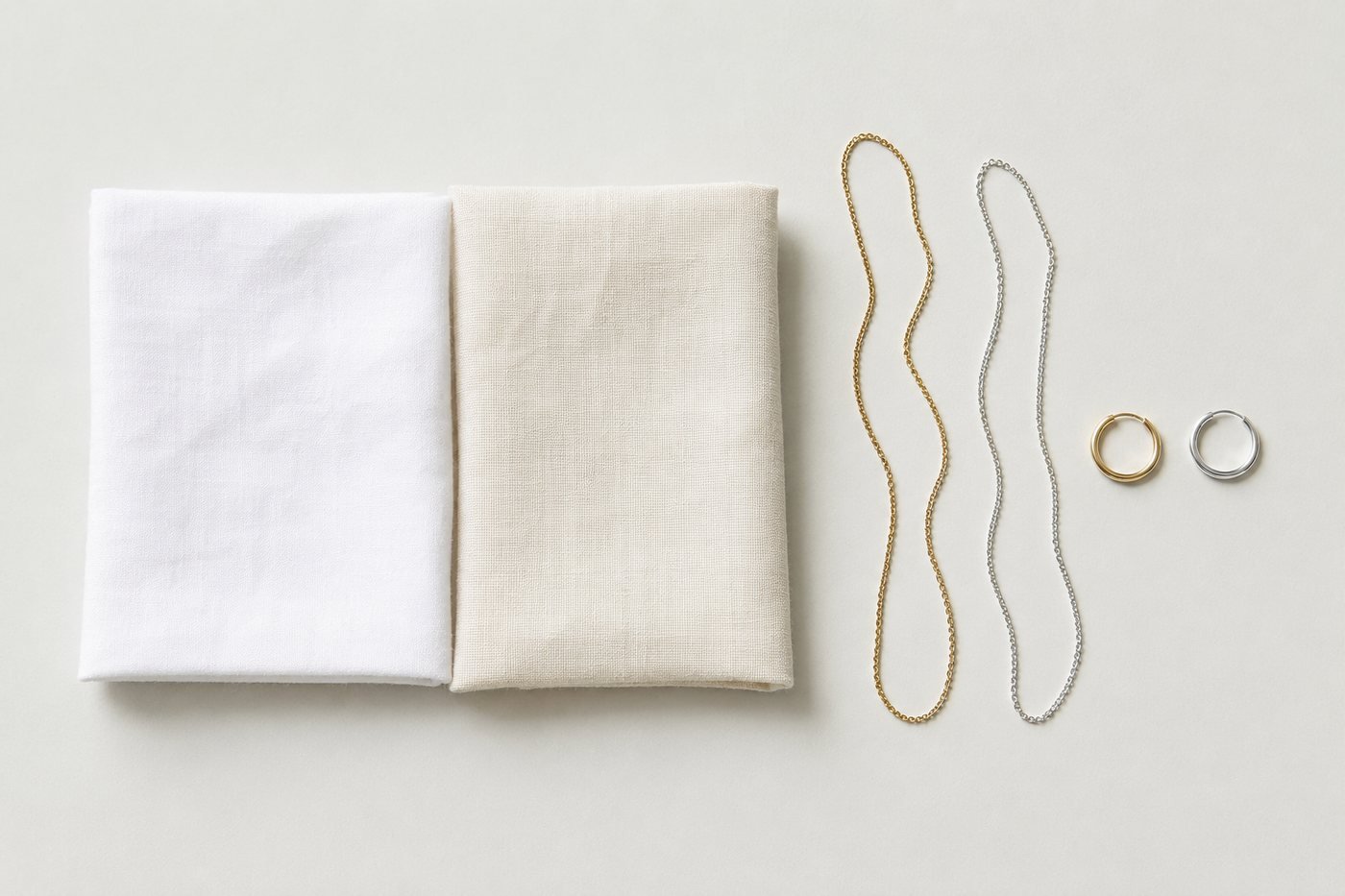
- — Hold a pure white shirt next to your bare face. If white washes you out and cream is more flattering, you are warm. If white makes you look bright and cream looks sallow, you are cool.
- — Try silver and gold jewelry side by side. The one that disappears into your skin in a good way — that is yours.
If three different tests all say the same thing, you have your answer. If they disagree, keep reading.
What "undertone" actually is
"Undertone" gets confused with "skin tone" and they are not the same thing.
Skin tone is your surface depth — fair, light, medium, tan, deep. It changes with the seasons. It changes with sun. It can be summarized by a foundation shade like Light 04 or Medium 30.
Undertone is the hue underneath the surface, and it does not change. Whether your skin reads pale in January or bronze in August, the warm-or-cool quality underneath stays the same. This is what color analysis is really tuning to — because clothing that picks up on your undertone harmonizes with you, and clothing that fights it makes your face look tired.
There are three families:
- Warm. Yellow, gold, peach, or apricot under the surface. Often (but not always) paired with warm hair — auburn, chestnut, golden blonde — and eyes that lean hazel, green, or warm brown. Tans easily.
- Cool. Pink, rose, or blue under the surface. Often paired with ash hair — platinum, ash blonde, ash brown, cool black — and eyes that lean clear blue, grey-blue, or cool brown. Burns more easily.
- Neutral / olive. A balance of both. We will come back to this — it is more common than the rest of the internet admits.
Real undertone reading is more reliable when you triangulate across several signals.
The five at-home tests
Read these in order. The wrist test is the most famous, but the foundation-history test is actually the most reliable — and the one almost no guide tells you about.
1. The wrist test
Roll up your sleeve and look at the inside of your wrist in natural daylight near a window. Not under warm bulbs — they shift everything. Not under fluorescent office lighting either.
- — Veins look green or olive → warm. Your yellow-pigmented skin filters the blue out of the venous blood, making it read green.
- — Veins look blue or purple → cool. Cool skin lets the blue through cleanly.
- — A clear mix of both, or you genuinely cannot tell → neutral.
Green-leaning
Green or olive. Yellow-pigmented skin filters the blue out of venous blood.
Blue-leaning
Blue or violet. Cool skin lets the blue through cleanly.
Caveats: very pale, translucent skin (common in cool seasons like True Summer) can make veins read blue even when undertone is neutral. And a recent tan throws the read. Take this test as one signal among many.
2. The white vs cream test
Pull a pure white t-shirt or sheet of paper, and a cream or ivory one, and hold each in turn directly under your bare face in front of a mirror. Wash makeup off first. Daylight, not lamp.
- — Cream is more flattering, pure white makes you look pale or yellow → warm.
- — Pure white makes your face look bright and even, cream makes you look slightly sallow → cool.
- — Both look fine, neither dramatically better → neutral.
Pure white
Brightens and evens cool skin. On warm skin it drains the face and can read yellow.
Cream
Rests warm skin. On cool skin it turns slightly sallow.
This is one of the more reliable tests because it isolates a single variable — the warmth or coolness of a near-white — and lets your face be the judge.
3. The silver vs gold jewelry test
Hold a silver piece up to one side of your face, a gold piece to the other. Plated pieces are fine; the cleaner the metal, the clearer the read.
- — Gold "warms up" your face and silver looks harsh → warm.
- — Silver makes your skin look luminous and gold looks dull → cool.
- — Both work, with a slight preference for one → neutral.
Silver
Makes cool skin look luminous; on warm skin it reads a little harsh.
Gold
Warms up warm skin; on cool skin it goes dull and sits on the surface.
Important: if you have worn one metal exclusively for ten years, your eye will be biased toward it. Compare both in the same five minutes, in daylight, and get a second opinion if you can.
4. The sun reaction test
Ignore products and lighting for a moment and think about your skin's biology.
- — Tans easily, rarely burns, takes on a golden or olive color in the sun → warm or olive.
- — Burns first and tans little, freckles, takes on pink before brown → cool.
- — Burns once, then tans → can be neutral.
Genetics dictates this and it does not change. It is a slower test — you cannot run it in your kitchen tonight — but if you can remember what your skin actually does in summer, it is a strong signal.
5. The foundation history test
This is the most-overlooked test and the most reliable one. Open your makeup drawer and look at the foundation, concealer, and powder that have worked for you over the years.
- — Shades labeled "warm," "golden," "honey," "beige" have always matched you; anything labeled "cool" or "pink" has looked grey or ashy → warm.
- — Shades labeled "cool," "pink," "porcelain," "rose" have matched; "warm" or "golden" foundations have always looked too orange → cool.
- — You have had matches in both families depending on the brand → neutral, or you have been buying shades that are not quite right (very common).
Foundation companies have spent decades testing thousands of women's skin against pigment chemistry. If three of your top-five favorite foundations all live in the same warm-or-cool column — believe them.
What if my results are mixed?
You might run all five tests and still land somewhere fuzzy. That is not a sign of failure. It is a sign that you are one of two extremely common undertones that get under-discussed:
Neutral undertone. A roughly balanced mix of warm and cool. About 30% of women fall here. Neutrals can wear a wider color range than pure warms or pure cools, but they look best in softened versions of any color — never the most saturated extreme. The 12-Season system reads neutral undertones as either Soft Summer (cool-leaning neutral) or Soft Autumn (warm-leaning neutral), depending on which side of center you fall.
Olive undertone. Skin with a noticeable green or gold-green cast. Olive can read warm at first glance but behaves differently — true olive tones look ashen in pink-based makeup and in pure yellow-based makeup, and tend to suit muted, earthy, slightly desaturated colors best. Olive most often maps to Soft Autumn, True Autumn, or Deep Autumn in the 12-Season system.
In either case, the answer is not "you are broken" — it is that you sit on the spectrum rather than at the extremes, and your best palette will be a slightly muted version of whichever direction you lean.
From undertone to your full season
Undertone is the first of three questions in 12-Season color analysis. Once you have it, the rest of the system gets dramatically simpler. The three questions:
- Undertone — warm, cool, or neutral. (You just answered this.)
- Depth — light, medium, or deep. How much pigment your hair, eyes, and skin carry collectively.
- Chroma — clear (saturated, jewel-bright) or muted (softened, dusty, earthy).
Take those three together and you land in exactly one of twelve seasons. Each has its own page on the site with the full palette, a wardrobe guide, and the colors to avoid.
The Twelve
Light Spring
Warm, light, clear — sunlit pastels.
True Spring
Warm, medium, clear — bright and golden.
Bright Spring
Warm-leaning, clear — jewel tones with warmth.
Light Summer
Cool, light, soft — pastel and powdery.
True Summer
Cool, medium, soft — dusty rose and slate.
Soft Summer
Cool-leaning neutral, muted — quiet and chic.
Soft Autumn
Warm-leaning neutral, muted — honey and sage.
True Autumn
Warm, medium, muted — rust, mustard, olive.
Deep Autumn
Warm, deep, muted — earthy and rich.
Bright Winter
Cool-leaning, clear — saturated and electric.
True Winter
Cool, deep, clear — black, white, true red.
Deep Winter
Cool, deep, clear — dramatic jewel tones.
Common mistakes & gotchas
A few things that throw off undertone reading and how to correct for them:
- Tested under warm bulbs. Tungsten and "warm white" LED bulbs shift everything yellow. Always test in north-facing daylight if possible, or step outside.
- Tested with a fresh tan or sunburn. Wait until your skin returns to baseline. Try the test in mid-winter, when surface color is least disrupted.
- Hair color throwing your eye. Dyed-blonde brunettes commonly think they have gone "warm" because their hair is now warm. Hair changes; undertone does not. Cover your hair with a neutral towel during the test and look at your face only.
- Never seeing yourself without makeup. Take it all off first. The point is to see what your actual skin is doing.
- Hunting for a clean answer that does not exist. Neutral and olive undertones are real. If three tests say warm and two say cool, you may simply be a warm-leaning neutral. That is information, not failure.
Frequently asked
Can my undertone change over time?
No. Skin tone — the surface depth, light to deep — lightens or darkens with sun, age, and pregnancy. But undertone, the warmth or coolness underneath, is genetically determined and stays the same for life.
Does my hair color affect my undertone?
Natural hair color is a clue to undertone, but not a cause of it. Dyed hair has no effect on what your skin is doing underneath — it just confuses the visual assessment. Always test undertone with your hair pulled back or covered.
Why do different guides give me different answers?
Because most rely on a single test, usually the vein test. Any single test can be misled by lighting, a recent tan, or hair color. Triangulating across three or more tests is much more reliable than trusting one.
Is olive a different undertone, or just a kind of warm?
Olive is its own category. Olive skin has a green cast that behaves differently from pure warm or pure cool — it tends to look ashen in colors that work fine on others. Olive most often maps to a Soft, True, or Deep Autumn in the 12-Season system.
Once I know my undertone, what is the single most useful clothing rule?
For warm undertones, gravitate toward colors that look like they grew out of the earth — golds, rusts, olives, cream, warm reds. For cool undertones, gravitate toward colors that look like they came from a glacier — clear blues, true reds, plums, icy pastels, jewel tones. Then refine from there using your depth and chroma — your full season.
Take The Reading
Find your full season
in about a minute.
Undertone is the first move. The Your Style Hue reading measures undertone, depth, and chroma together — and matches all three to one of twelve specific palettes built for you. The reading happens entirely in your browser. Your photograph never leaves this device.
Find my colors