Shop the carousel
The fall jacket, by season
One packable puffer, fifteen colors, eleven seasons. The cut never changes — only the color does, which is exactly what makes it a color test rather than a shopping list. The eleven below are grouped by how much weight each color carries rather than by season family, because weight is the axis this range actually varies on. The twelfth season is not in the bands, and there is a section further down that says why instead of a color picked to fill the gap.
The jackets below are Amazon links, and Your Style Hue earns a commission if you buy through one — at no extra cost to you. Nothing here is paid placement. Each piece was chosen because its color actually matches the shade it sits under. Most come in a dozen colors, so check the one on Amazon matches before you buy.
The answer for every season · tap yours


01 · Start at the pale end
The light four
Four colors from the pale end of the range, and they are not four variations on one idea — a clean white, a warm coral, a lit golden ginger and a soft lilac have nothing in common except that not one of them is dark.
Why this worksLess
That is the point of banding a jacket by weight rather than by family: what puts these four together is how much of the picture they take up, and weight is the thing you can genuinely see from across a parking lot. It is also the shortest stretch of any outerwear rail, because coats get bought dark out of habit. A jacket from this end is harder to find, and it is the one that will read as a decision rather than as a default.
The seasons
- Bright WinterShop this one
The white. You are one of the few who can wear it this clean. Snow White is the white your palette gives you, and a softened cream would only put a warm film over the thing that makes your coloring work.
- Light SpringShop this one
The apricot. Warmer than it looks on screen — coral, not peach. This is your Soft Coral, which your season page gives you as your blush tone, and it is doing at outerwear scale what a blush does at the cheek.
- True SpringShop this one
The ginger. Golden and lit, which is your whole palette in one color. Your palette lists this shade as Marigold, and it is the warm end of the range doing what nothing else here can do for you.
- Light SummerShop this one
The lilac. Your Wisteria, almost exactly — light enough to sit at your own weight rather than above it, which is the whole difficulty with buying outerwear when your coloring is soft and light.

The light four
TACVASEN packable quilted puffer, White
The light four
4.5★ (617 ratings)
Shop the one picturedA second source for this band
Amazon Essentials water-resistant packable puffer, Stone
4.4★ (5,606 ratings)
A different brand at the same end of the ladder, so this band does not rest on one listing. Stone is a pale warm cream rather than any of the four colors above, which makes it the neutral option at this weight if the color you want is out of stock in your size.
Shop the Amazon Essentials02 · Where the range gets interesting
The middle three
Three colors, and this is the stretch that decides whether a jacket range is any good.
Why this worksLess
A mid periwinkle, a muted warm khaki and a clear cobalt sit at roughly the same weight and could not be further apart in temperature — and temperature is the entire argument at mid depth, because this is where a color is strong enough to be read as a color rather than as a neutral. Anyone can dye a black puffer. Carrying three genuinely different mid tones on one silhouette is rarer than it sounds, and it is most of the reason this listing is the one on this page.
The seasons
- True SummerShop this one
The light blue. A periwinkle rather than a baby blue, and that matters: Periwinkle is the blue your palette actually names, and it has enough depth in it to hold its own against your coloring instead of floating off it.
- Soft AutumnShop this one
The khaki. Muted, warm, a little olive. Nothing about it shouts — which is exactly why your palette lists Warm Khaki as a quiet neutral, and why it is the one color in this range built at your volume.
- Bright SpringShop this one
The azure. A clear cobalt — a blue most people genuinely cannot wear. Cobalt is the color your season page hands you in place of a navy, and this range is the first one in three that has carried a real one.

The middle three
TACVASEN packable quilted puffer, Light Blue
The middle three
4.5★ (617 ratings)
Shop the one picturedA second source for this band
Amazon Essentials water-resistant packable puffer, Olive
4.4★ (5,606 ratings)
A second brand covering this band, and the honest note is that its olive runs a step deeper and greener than the khaki above rather than matching it. If you are Soft Autumn and the khaki has gone, this is the nearest thing on another listing.
Shop the Amazon EssentialsTwo down, two to go
Not sure which of these is describing you?
That’s the normal answer, and it’s the whole reason the analysis exists. It reads your undertone, depth and contrast from a photograph and tells you which of the twelve seasons you are — which settles the blazer question in about a minute.
03 · And the ones that read as dark
The deep four
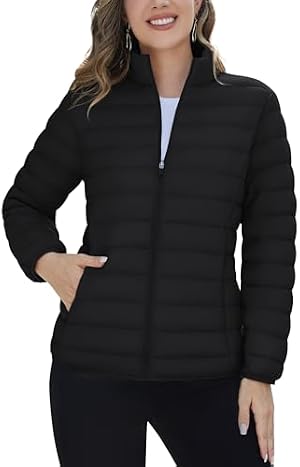
A true red, a deep emerald, a brick and a black.
Why this worksLess
From ten feet away all four simply read as dark, and that is the trap in this band: at this depth the only variable you have left is temperature, and temperature is invisible on a hanger and unmistakable under your chin. Two of these are warm and two are cool, and getting that one thing right is the difference between a jacket that reads as considered on you and one that reads as heavy. It is also the band where most people stop looking, because it is the band with the black in it.
The seasons
- True WinterShop this one
The tomato red. This is a true red, and true red is yours — True Red is the color your season page tells you to wear at the face, and an outer layer is the largest place you will ever get to put it.
- Deep AutumnShop this one
The emerald. Deep enough to read as forest on you, and Forest is the color your season page gives you as your depth. It is the one green in this range that does not go bright the moment it catches the light.
- True AutumnShop this one
The dark orange. It is not orange. It is brick, and brick is yours — Brick sits half a step from the Rust your palette gives you, and at this size half a step is nothing.
- Deep WinterShop this one
The black. Charcoal-deep, and you can take it at full strength. Charcoal is the color your season page puts in your coat, which is precisely what this is — you are one of the few people on this page for whom the default was the right answer all along.

The deep four
TACVASEN packable quilted puffer, Black
The deep four
4.5★ (617 ratings)
Shop the one picturedA second source for this band
Amazon Essentials water-resistant packable puffer, Black
4.4★ (5,606 ratings)
A second brand at the dark end. Black is the one color it covers of the four above — for the red, the emerald and the brick, the TACVASEN listing is the one that carries them at this depth.
Shop the Amazon EssentialsThe twelfth season
Soft Summer, this one doesn’t have your color.
Fifteen colors and not one of them is greyed. Everything here is either clear or deep, and yours live in between. Scored against all fifteen, the nearest thing in this range to a Soft Summer color sits further from you than every other season’s pick sits from them — and moving the picks around does not fix it, because the color is not in the range to move.
That is a fact about this brand’s range and nothing wider. Plenty of technical fabric takes a muted color perfectly well; a competing quilted range measured on the same day is soft the whole way through, and it fails three other seasons instead. Ranges have characters, and this one’s character is clarity.
So look for ash rose, pewter or smoky mauve instead. Ash Rose is the one your season page tells you to wear at the face, Pewter is your anchor neutral, and Smoky Mauve is your depth. They exist — they are just not in this range. Your season page names all three, with the rest of your palette alongside them.
We could have handed you the pink with an asterisk. It is a perfectly nice jacket and it would not have done you any harm. But it is not yours, and a page that tells eleven people the truth and one person a near-miss is worth less than one that says so out loud.
The rule underneath it
Why the jacket is the one worth getting right.
You will be photographed in this more than in anything else you own between now and March. It goes on over every outfit, which makes it the color people actually associate with you all season — the one in the pickup line, in the group shot at the airport, in every picture taken outdoors for six months. And it is the one garment most people buy in black by default, without ever asking whether black is theirs.
A jacket is also a more forgiving test than a neckline and a less forgiving one than a pair of jeans, and the reason is where it sits. A puffer’s stand collar comes up to the jaw, so a few inches of it are inside the range where a color bounces light straight up into your face. The rest of it — the body, the sleeves, the whole visual mass — sits out at arm’s length, where it behaves like a field rather than like a light source. You get both effects at once and they pull in different directions. That is why a jacket color which is slightly off is survivable in a way a wrong scarf is not, and why a jacket color which is right does more work than a right pair of pants ever could: there is simply more of it, and it is up where you are being looked at.
Which is also why the default black is worth asking about rather than defending. Black is not the absence of a choice; it is a choice, and on some of the twelve seasons it is a strong one — it drops the weight of the picture below your face and lets your features carry it. On others it does the opposite, and the tell is always the same: your eye goes to the shadow under your jaw instead of to your eyes. If you have ever looked at a photograph of yourself in a black coat and thought you looked tired in it, that is what you were seeing, and it was not the photograph.
None of this is an argument for owning a colored jacket you will not wear. It is an argument for spending the one decision you get. Most people buy an outer layer every few years and then wear it more or less daily for a season — one decision against a few hundred wearings. That ratio is the best return on getting a color right that exists anywhere in a wardrobe, and it is why this is the garment worth ten minutes rather than the scarf.
Still deciding
Common questions.
- Your coat guide gave me a different color. Which one is right?
- Both, because they answer different questions. The coat guide asks what your outerwear neutral is — the one coat you buy for several years and wear over everything, which is why five of its six answers are neutrals and why it can only give you one. This page asks something narrower and more specific: of the fifteen colors this one jacket happens to come in, which one is yours. That is a color test run on a fixed garment, not a recommendation about the whole category. If you are buying the single coat that has to work with everything you own, take the coat guide’s answer. If you are buying a second layer and you want it to be a color, take this one.
- Why is every pick on this page the same jacket?
- Because color is the only thing this page is arguing about, and holding the garment constant is the only honest way to show it. Eleven different jackets in eleven different colors would prove nothing — you would be comparing cuts, weights, collars and how flatteringly each one happened to be photographed. Holding the silhouette still means the only variable left in the picture is the one being tested. The rule carries over to whatever shape you actually wear: a wool coat, a shacket, a quilted vest, a parka. Take the color from your band and buy the cut you like.
- A colored puffer feels like a lot. Will I regret it by February?
- The thing people regret is usually the particular shade they were not sure about, not the fact that it was a color at all. There is a simple test for it before you order. Look at the coats already hanging by your door and ask what you reach for when you are late and not thinking — most people find they own three or four and wear one of them almost exclusively. If that favorite is a color, you are not the person this question is for. If it is black and you have never quite liked how you look in it, the section above is describing you, and the fix is not a bolder color so much as the right one at any strength. A muted khaki and a clear cobalt are equally correct answers here; they just belong to different people.
- I am Soft Summer. What do I actually buy?
- Not this jacket, and the note above the questions explains why at length. What to look for instead is a greyed color rather than a clear one or a dark one: ash rose, pewter, smoky mauve, a soft slate. Those are the shades your palette is built from and they are simply absent from this particular range. They are not rare in outerwear generally — quilted ranges that skew muted do exist, and one of them was measured against this one on the same day and serves you far better than anything here. It is not on this page because Amazon flags that listing as a frequently returned item, which is not somewhere to send you. Your season page lists all three colors by name, so take those names shopping and judge a listing by the photograph rather than by what the shade is called on the tag.
- I am between two seasons. Which color do I take?
- Split on depth first, because depth is the axis these three bands are built on and it is much the easier of the two to see in a mirror. Ask whether a strong dark color anchors you or swallows you — that answer alone usually decides whether you belong in the deep four or nearer the pale end. Only then ask about temperature, by holding the two candidates up under your chin in daylight and watching your skin rather than the jacket. The right one evens your face out slightly, as though you have slept. The wrong one drops a faint grey or a faint yellow into it and sends your eye to the shadows. If your two candidate seasons sit in the same band here, either color will serve you and you can stop worrying about it.
Before you go
Get the rest of your season’s shopping list.
One short letter every few weeks — the pieces, the colors and the swaps for your season specifically, not all twelve. No spam, and you can leave whenever you like.
Issue 02 · September 2026Fall only sells you two redsRead it first
Keep shopping
Everything for your season.
Pick your season to see every guide's answer for you, in one place.
Don’t know which one you are?
Find your season in a minute.
Upload a portrait and the analysis runs entirely in your browser. Your photo never leaves your device — there’s no server to send it to.
Find my colorsUndertone, depth and contrast are what decide which of the four neutrals is yours. The analysis measures all three rather than asking you to guess from a description.